This article explains the three methods used by DiliTrust to compute detention and control percentages across corporate structures. These calculations are based on established standards for computing corporate ownership and control (source: auditsi). To see how these percentages are reflected visually, refer to the Orgchart – Overview & Help Center.
Method 1 — Direct & Indirect Detention
The total detention of a parent company in a subsidiary is the sum of all direct and indirect ownership paths.
Each indirect path is calculated by multiplying the stake percentages along every link in the chain.
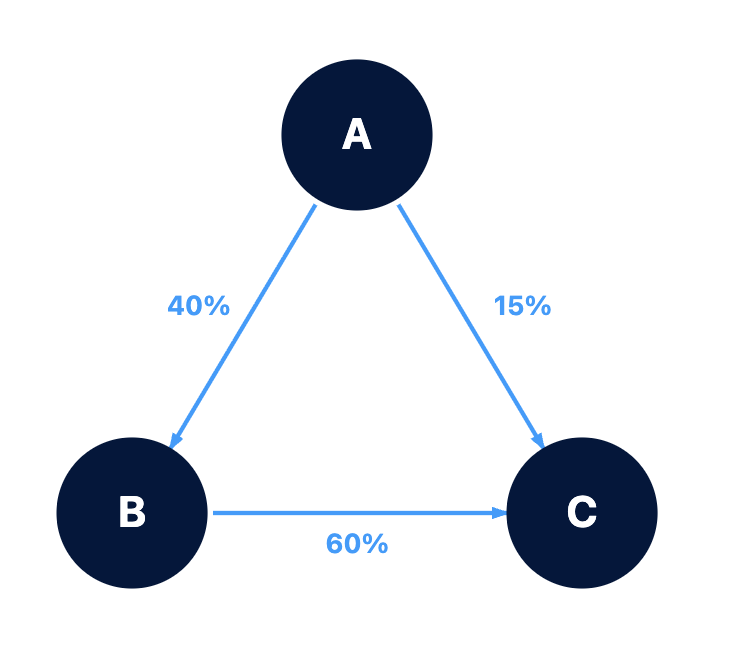
Example to calculate how much C is owned by A:
A owns 40% of B and 15% of C directly. B owns 60% of C.
- Indirect path: 40% × 60% = 24%
- Direct stake: 15%
- Detention of A with respect to C:
%A→C = 24% + 15% = 39%
Method 2 — Direct & Indirect Detention with Cross-Ownership
When two subsidiaries hold shares in each other, a circular ownership loop is created. The standard formula must be adjusted to avoid counting these circular paths multiple times.
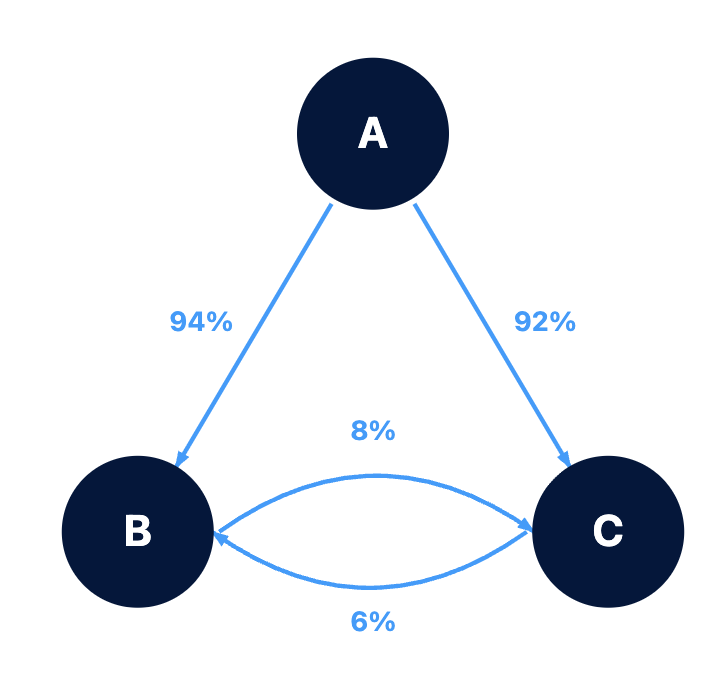
Example to calculate how much C is owned by A:
A owns 94% of B and 92% of C. B owns 8% of C. C owns 6% of B.
Step 1 — Compute the cross-ownership factor (φ):
- φ = 8% × 6% = 0.48%
Step 2 — Compute the adjusted detention:
- %A→C = (94% × 8% + 92%) ÷ (1 − 0.48%) ≈ 100%
The denominator (100% − φ) neutralises the circularity created by the cross-ownership loop.
Method 3 — Direct & Indirect Control with Majority Threshold
When computing control (rather than simple detention), only companies where the parent holds more than 50% of voting rights are taken into account. Below this threshold, the chain is broken and the entity's holdings are excluded. To visualise control chains directly in DiliTrust, see How to Display the Ownership Chain.
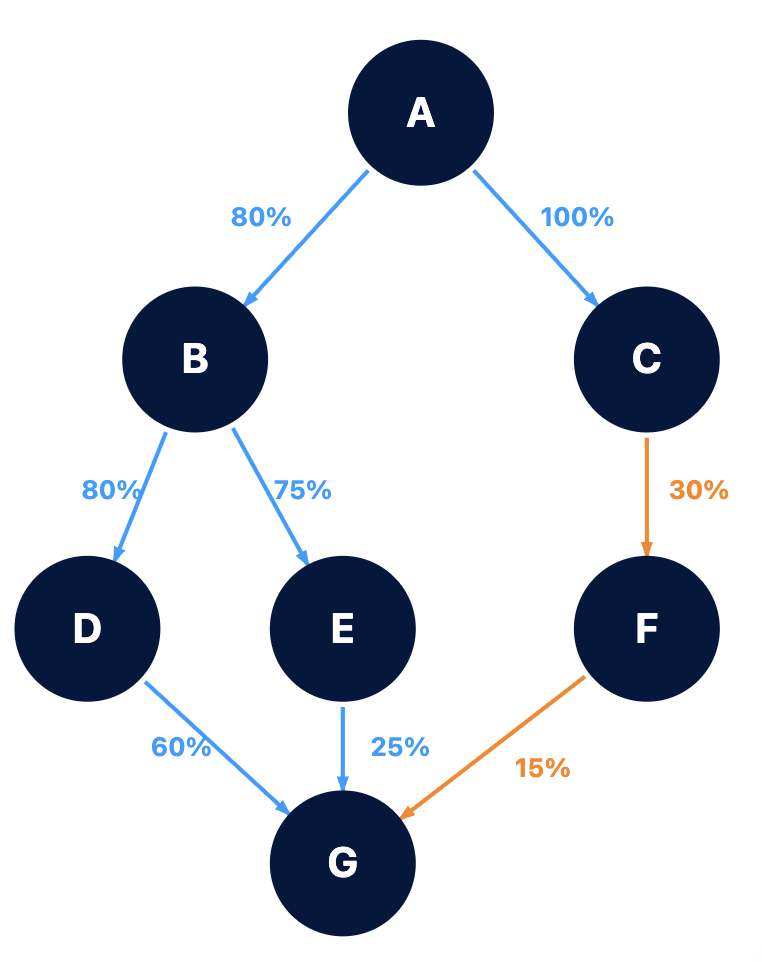
Note: percentages in this diagram represent voting rights, which may differ from economic ownership in structures involving multiple share classes or double voting rights.
Example to calculate how much G is controlled by A:
A controls B (80%) and C (100%). B in turn controls D (80%) and E (75%). C holds 30% of F. D holds 60% of G, E holds 25% of G, F holds 15% of G.
- D is controlled by A via B (A→B: 80% > 50%, B→D: 80% > 50%) → D's 60% in G is included ✓
- E is controlled by A via B (A→B: 80% > 50%, B→E: 75% > 50%) → E's 25% in G is included ✓
- F is not controlled by A (C→F: 30% < 50%) → F's 15% in G is excluded ✗
%A→G (voting rights) = 60% + 25% = 85%
F's 15% stake in G cannot be consolidated into A's control scope because the link C→F (30%) falls below the 50% majority threshold, meaning F is not considered a controlled entity.
See also: Orgchart – Best Practices | How to Export the Orgchart | Org Chart – FAQ & Troubleshooting
Was this article helpful?
That’s Great!
Thank you for your feedback
Sorry! We couldn't be helpful
Thank you for your feedback
Feedback sent
We appreciate your effort and will try to fix the article